The total solar eclipse of 2 August 2027, and every eclipse of the year
On 2 August 2027 the Moon covers the Sun along a path from southern Spain across North Africa to Arabia. Where totality falls, checked place by place, and what astrologers make of an eclipse in Leo.
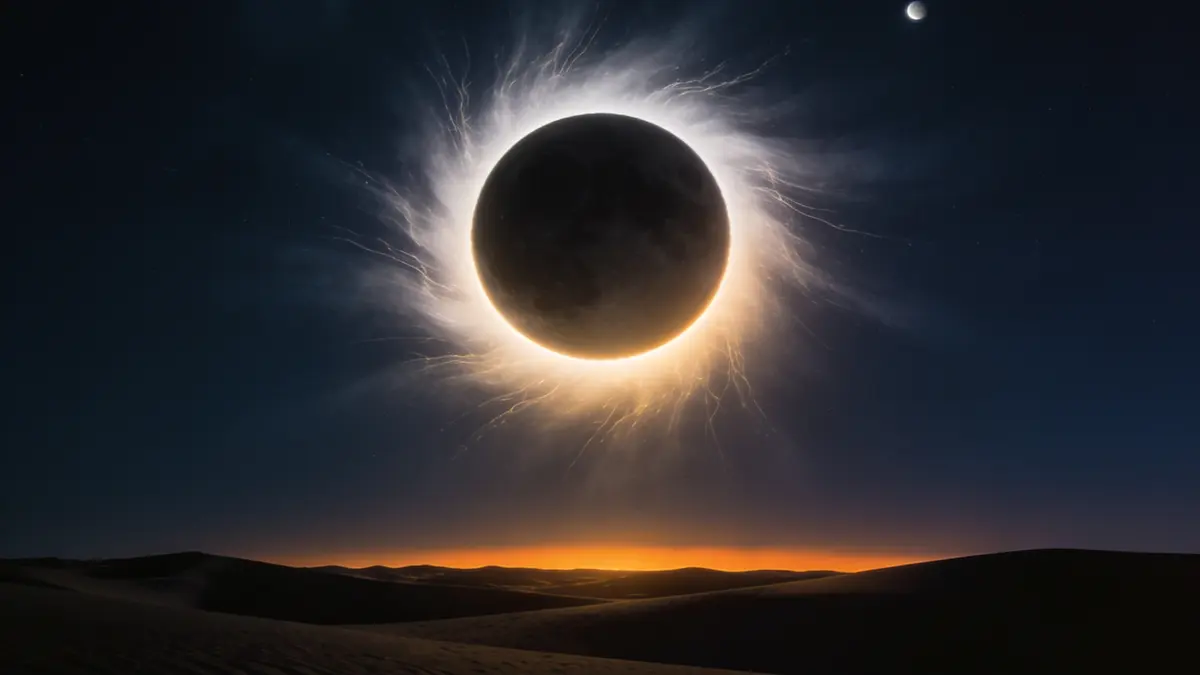
Illustration. The dates and positions in this article are computed; the picture is not a photograph of the event.
On Monday 2 August 2027 the Moon passes directly in front of the Sun and, along a narrow track, day turns briefly to night. Greatest eclipse is at 10:06 UTC, near latitude 25.5 and longitude 33.2, in southern Egypt. The Sun is in Leo at the time. Every place, time and duration below was computed for this page, city by city; times are UTC.
Where totality falls
Only places inside the Moon's full shadow see a total eclipse. Of the places we checked, these are inside it, in the order the shadow reaches them as it crosses from the Atlantic towards Arabia:
| Place | Totality (UTC) | Totality lasts | Sun above horizon |
|---|---|---|---|
| Cadiz, Spain | 08:46 UTC | 2 min 53 s | 37 degrees |
| Tangier, Morocco | 08:46 UTC | 4 min 54 s | 38 degrees |
| Gibraltar | 08:47 UTC | 4 min 29 s | 38 degrees |
| Malaga, Spain | 08:48 UTC | 1 min 51 s | 39 degrees |
| Benghazi, Libya | 09:30 UTC | 6 min 13 s | 68 degrees |
| Luxor, Egypt | 10:05 UTC | 6 min 25 s | 82 degrees |
| Jeddah, Saudi Arabia | 10:25 UTC | 6 min 02 s | 76 degrees |
| Mecca, Saudi Arabia | 10:26 UTC | 5 min 11 s | 75 degrees |
The longest totality among these is at Luxor, Egypt, 6 min 25 s, with the Sun 82 degrees up, nearly overhead. That length is what makes this eclipse unusual: most totalities last two or three minutes.
Just outside the track the Sun is only partly covered, which is a very different experience. The sky does not go dark and the corona never appears:
| Place | Greatest eclipse (UTC) | Share of the Sun covered |
|---|---|---|
| Aswan, Egypt | 10:08 UTC | 99.8 percent |
| Tunis, Tunisia | 09:09 UTC | 97 percent |
| Aden, Yemen | 10:51 UTC | 96.1 percent |
| Cairo, Egypt | 09:55 UTC | 94.8 percent |
| Lisbon, Portugal | 08:44 UTC | 92.5 percent |
| Madrid, Spain | 08:51 UTC | 86.2 percent |
| Paris, France | 09:01 UTC | 51.2 percent |
| London, UK | 09:00 UTC | 41.8 percent |
Every eclipse of 2027
| Date | Type | Kind | Sign |
|---|---|---|---|
| 6 Feb 2027 | Solar | Annular | Aquarius |
| 20 Feb 2027 | Lunar | Penumbral | Virgo |
| 18 Jul 2027 | Lunar | Penumbral | Capricorn |
| 2 Aug 2027 | Solar | Total | Leo |
| 17 Aug 2027 | Lunar | Penumbral | Aquarius |
Eclipses come in pairs about two weeks apart, a solar eclipse at a new moon and a lunar eclipse at a full moon, whenever those fall close to the points where the Moon's tilted orbit crosses the Sun's path. A penumbral lunar eclipse is the faintest kind: the Moon only dims slightly, and many people never notice it.
What astrologers make of it
In astrology, eclipses are the loud version of a new or full moon: turning points, beginnings and endings that feel as if they arrive from outside. A solar eclipse, a new moon at its most intense, is read as a door opening. This one falls in Leo, the sign of the Sun itself: creativity, visibility, pride and the heart, so it is traditionally read as a reset of how you shine and what you love doing.
The honest caveat is the same as for any sky event. An eclipse is a real, spectacular alignment, and the meaning people give it is a tradition of reflection, not a force acting on your life. If it prompts you to begin something you care about, that is a good use of it. Where Leo sits in your own chart decides which part of life the tradition would point to; a full reading works that out.
Closer to now, our full moon calendar lists every full moon of the coming year.
Sources and method
- astronomy-engine, the ephemeris used for every time, place and duration here
- NASA: eclipse safety
- American Astronomical Society: solar viewers and ISO 12312-2
Every date and position above is recomputed on each build of this site from the ephemeris, geocentric and in the tropical zodiac, the same way our daily readings are made. Astrology is a reflective practice, not a science, and nothing here predicts an outcome.